|
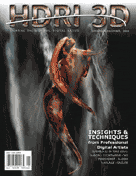
I will only be reviewing this first
edition of the magazine.
If you are at all familiar with
this magazines predecessor Keyframe Magazine then
you will not be dissappointed. All the same
feature article authors are still there with a
couple of additions for the Maya and XSI content.
The writing in the articles is generally
excellent. So
far the content to ad ratio is very good.
There is only 8 pages of ads to the 84 pages of
the magazine (this page count includes the
covers). In fact lets break this down a bit
-
1 page is the Front cover
2 pages of Index
5 pages of editorial (okay the first page is from
the editor Dan Ablan, there is also a 3 page
article on "The philosophy of 3D and
Life" and a 1 page comment article at the
back of the magazine). All of which I
personally found to be good and well worth
reading.
2 pages of an article on the Stargate SG-1 Emmy
Nomination. I like hearing about people in
the industry so this gets a thumbs up as well.
1 1/2 pages of a review of what looks like a
killer computer system.
Now the stuff you really care about - how much of
this is devoted to various 3D packages : 18.5
pages to LightWave (Saslite, MultiPass Rendering,
Faking Multiple Cameras,Explosions with
Hypervoxels plus 5 pages in the photoshop tutorial
on creating steam using particles.
11 pages to Photoshop (create the front cover art
using Photoshop with some pages using LightWave to
create steam/particle effects in the image)
25 pages to Maya (Model and Rig a game character,
The Maya API Command Plug-In and Quick and Dirty
Cloth))
4 pages to Modo (A quick starter modeling
tutorial)
3 pages to XSI (Integrating CG into real world
environments)
3 pages to Mirage (Cool Effects) Myself,
I don't use Maya, or XSI or Mirage or Modo but I
still found some use in some of the tutorials for
the other programs. I skipped right over the
tutorial on the Maya API but it does look fairly
indepth judging by its length. The Modo
tutorial is easy for a LightWaver to follow as it
is very similar to LightWave (probably due to the
fact that it was designed/written by the same
guys). The XSI tutorial I start reading but
the way LightWave and XSI look at things is a
little different and I was just getting confused
so I left it. I don't use Mirage but it
looks kinda cool so this may come in handy for
myself in the future. The
photoshop tutorial is very long and in depth and
includes some LightWave steam creation. A
good tutorial in my opinion. The rest of the
tutorials in the magazine that dealt with
LightWave were all equally good. I got
something from all of them but I probably got the
most from the amazing Explosions tutorial by
Deuce. Witty and informative - a great
read. All in all I
liked this first offering of HDRI 3D
magazine. I hope that future issues can
match this quality. If you are sceptical of
the use of other tutorials not devoted to your 3D
software I say to give it a chance. Read the
articles of the other programs and you will find
common ideas and techniques that can be carried
over to your program of choice. I liked the
Maya character creation tutorial. It will be
easy for me to carry over the knowledge into
LightWave even though I don't know Maya. And
if I ever find myself using Maya then I will have
some tutorials to help me out. This
first issue has very few ads and I expect that
that will probably increase in future
issues. If it does then that means that
people are buying the magazine and the companies
advertising find it a good value. If that is
the case then we may see even more content in the
magazine as a result.
|